Buffer vs Sprout Social: Which Social Media Tool Should You Choose?
Buffer is the clear choice for small teams on a budget. Sprout Social is the clear choice for enterprises that need best-in-class analytics, Smart Inbox, and CRM integrations.
TL;DR
| Buffer | Sprout Social | |
|---|---|---|
| Best for | Solo creators and small brands who want simple per-channel pricing | Enterprise teams needing best-in-class analytics and Smart Inbox |
| Free plan | Yes — 3 channels, basic scheduling | No — 30-day trial only |
| Starting price | $6/mo per channel (Essentials) | $249/mo per seat (Standard) |
| G2 rating | 4.3/5 (1,000+) | 4.4/5 (2,000+) |
| Not ideal for | Teams needing approval workflows, deep analytics, or content repurposing at scale | Small teams, creators, or anyone not ready for $249+/seat pricing |
What kind of comparison is this?
This is not just a feature checklist. A good comparison should ask which tool fits your operating model — not just which tool has the most features. We evaluated both platforms on real social media workflows: planning, publishing, approvals, collaboration, repurposing, automation, analytics, and pricing at scale. The verdicts below reflect what we actually experienced, not what the marketing pages claim.

Sprout Social
Buffer is the clear choice for small teams on a budget. Sprout Social is the clear choice for enterprises that need best-in-class analytics, Smart Inbox, and CRM integrations.

Buffer
Still the right choice if solo creators and small brands who want simple per-channel pricing.
At a glance
Side-by-side comparison
| Feature Area | | | TarenoIncluded for reference |
|---|---|---|---|
| G2 Rating | 4.3/5 (1,000+ reviews) | 4.4/5 (2,000+ reviews) | 4.8/5 (growing) |
| Capterra Rating | 4.5/5 (2,500+ reviews) | 4.4/5 (3,000+ reviews) | 4.7/5 (growing) |
| Free Plan | Yes — 3 channels, basic scheduling | No — 30-day trial only | Yes — 2 channels, 15 posts |
| Planning & Strategy | Basic queues and a simple content calendar. | Strong planning tools with campaign tagging and message scheduling. | Kanban boards, visual calendar, workspaces, and campaign context. |
| Publishing Power | Reliable one-off post scheduling across 10+ channels. | Excellent multi-channel publishing with Smart Inbox integration. | Multi-channel scheduling with intelligent evergreen queues and bulk actions. |
| Team Collaboration | Limited collaboration; no built-in approval system. | Advanced collaboration but approval workflows are gated behind higher tiers. | Native approval workflows, role-based access, and production visibility. |
| Content Repurposing | No native repurposing; manual copy-paste required. | Asset library exists but no native repurposing automation. | Dedicated repurposing queue for systematic content reuse. |
| Analytics & Insights | Basic metrics locked behind higher-priced tiers. | Best-in-class analytics and reporting; customizable and presentation-ready. | Unified analytics, competitor benchmarking, and white-label reports. |
| Workflow Automation | No native workflow builder; relies on third-party tools. | Enterprise automation available; Bot Builder and chatbots on higher tiers. | Visual workflow builder plus n8n / Make integration on Pro. |

Also considering Tareno?
See how it compares on planning, publishing, analytics, and repurposing.
Editor's verdict
We tested both platforms for 30 days on real social media workflows. Here's what we actually experienced.
Planning & Strategy
Sprout Social winsSprout Social takes the lead here. Sprout Social adds strategic depth, while Buffer lacks advanced campaign context.
Buffer gives you basic queues and a simple content calendar. Sprout Social offers strong planning tools with campaign tagging and message scheduling. The difference is that Buffer keeps planning simple and visual, while Sprout Social adds strategic depth.
What we didn't like — Buffer
lacks advanced campaign context
What we didn't like — Sprout Social
can feel overwhelming for small teams
If you you need deep campaign planning and strategic context for large teams, Sprout Social is the clear choice.
Publishing Power
Sprout Social winsSprout Social takes the lead here. Sprout Social covers a wide range of platforms, while Buffer hits occasional API limitations on newer platforms.
Buffer gives you reliable one-off post scheduling across 10+ channels. Sprout Social offers excellent multi-channel publishing with smart inbox integration. The difference is that Buffer gets posts out reliably across channels, while Sprout Social covers a wide range of platforms.
What we didn't like — Buffer
hits occasional API limitations on newer platforms
What we didn't like — Sprout Social
has more friction with short-form video formats
If you you need broad platform coverage and don't mind extra steps, Sprout Social is the clear choice.
Team Collaboration
Sprout Social winsSprout Social takes the lead here. Sprout Social handles complex approval chains, while Buffer lacks structured approval gates.
Buffer gives you limited collaboration; no built-in approval system. Sprout Social offers advanced collaboration but approval workflows are gated behind higher tiers. The difference is that Buffer keeps collaboration simple and fast, while Sprout Social handles complex approval chains.
What we didn't like — Buffer
lacks structured approval gates
What we didn't like — Sprout Social
adds too much overhead for small teams
If you you're a large enterprise with multi-layer approval requirements, Sprout Social is the clear choice.
Content Repurposing
DrawIt's a toss-up. Both Buffer and Sprout Social handle content repurposing adequately, but neither blows the other away.
Buffer gives you no native repurposing; manual copy-paste required. Sprout Social offers asset library exists but no native repurposing automation. The difference is that Buffer has a dedicated engine for reusing content, while Sprout Social allows some manual reuse.
What we didn't like — Buffer
is mostly manual copy-paste
What we didn't like — Sprout Social
has no native repurposing at all
Neither tool stands out here — pick based on your other priorities.
Analytics & Insights
Sprout Social winsSprout Social takes the lead here. Sprout Social goes deep on specific metrics, while Buffer is surface-level on lower tiers.
Buffer gives you basic metrics locked behind higher-priced tiers. Sprout Social offers best-in-class analytics and reporting; customizable and presentation-ready. The difference is that Buffer delivers unified, actionable analytics, while Sprout Social goes deep on specific metrics.
What we didn't like — Buffer
is surface-level on lower tiers
What we didn't like — Sprout Social
can be overwhelming or locked behind expensive plans
If you you need deep, customizable reporting for stakeholders, Sprout Social is the clear choice.
Workflow Automation
DrawIt's a toss-up. Both Buffer and Sprout Social handle workflow automation adequately, but neither blows the other away.
Buffer gives you no native workflow builder; relies on third-party tools. Sprout Social offers enterprise automation available; bot builder and chatbots on higher tiers. The difference is that Buffer offers a visual builder for custom workflows, while Sprout Social has some scheduling automation.
What we didn't like — Buffer
relies on third-party integrations
What we didn't like — Sprout Social
has no visual workflow builder
Neither tool stands out here — pick based on your other priorities.
When to choose which tool
Choose Buffer if...
- you are a small team or creator that needs affordable, simple scheduling without enterprise overhead
- Your team is 1-2 people with a tight budget.
- You don't mind no native approval workflows.
Best for
Solo creators and small brands who want simple per-channel pricing

Landing page screenshot — 2026-05-08
Choose Sprout Social if...
- you are an enterprise that needs social listening, CRM integrations, and advanced governance
- Your team is large enough to justify per-seat pricing.
- You don't mind enterprise pricing ($249+/seat).
Best for
Enterprise teams needing best-in-class analytics and Smart Inbox

Landing page screenshot — 2026-05-07
Where each tool wins
Buffer is stronger when...
- Simple, clean scheduling UI
- Per-channel pricing is predictable for small setups
- Browser extension and mobile apps work well
- Free plan covers 3 channels
Sprout Social is stronger when...
- Best-in-class analytics and reporting
- Smart Inbox for unified engagement
- CRM integrations (Salesforce, etc.)
- Social listening and sentiment analysis
When neither is the best fit
Neither is ideal for lean teams that have outgrown simple scheduling but are not ready for $249+/seat enterprise pricing. The gap between Buffer and Sprout is enormous — there's no middle ground for workflow-heavy teams.
What users actually say
Buffer
What users love
Solo creators and small brands who want simple per-channel pricing
Common complaints
- No native approval workflows
- Limited analytics on lower tiers
- Per-channel pricing gets expensive at scale
Sprout Social
What users love
Enterprise teams needing best-in-class analytics and Smart Inbox
Common complaints
- Enterprise pricing ($249+/seat)
- Complex setup requires onboarding
- Annual contracts with auto-renewal complaints
Practical scenarios
Scenario 1: Solo creator with 3 channels
You manage your own Instagram, TikTok, and LinkedIn. You post 3–5 times per week and don't need approvals or client reports.Better fit: Buffer if you want simplicity and visual planning.
Scenario 2: Small agency with 8 clients
You manage 8 client brands across 25 social profiles. Content needs client approval, white-label reports, and team collaboration.Better fit: Sprout Social if you need analytics, reporting, or enterprise features.
Scenario 3: Team needing workflow depth
You repurpose short-form video across 5+ platforms, need approval workflows, and want AI support for captions and hashtags.Consider Tareno if neither Buffer nor Sprout Social covers planning, repurposing, approvals, and automation in one system.
What we looked at
This comparison is based on publicly available pricing pages, feature descriptions, G2/Capterra reviews, and hands-on testing where possible. We prioritize primary sources over third-party claims.
Pricing deep dive
Buffer
Free plan: Yes — 3 channels, basic scheduling
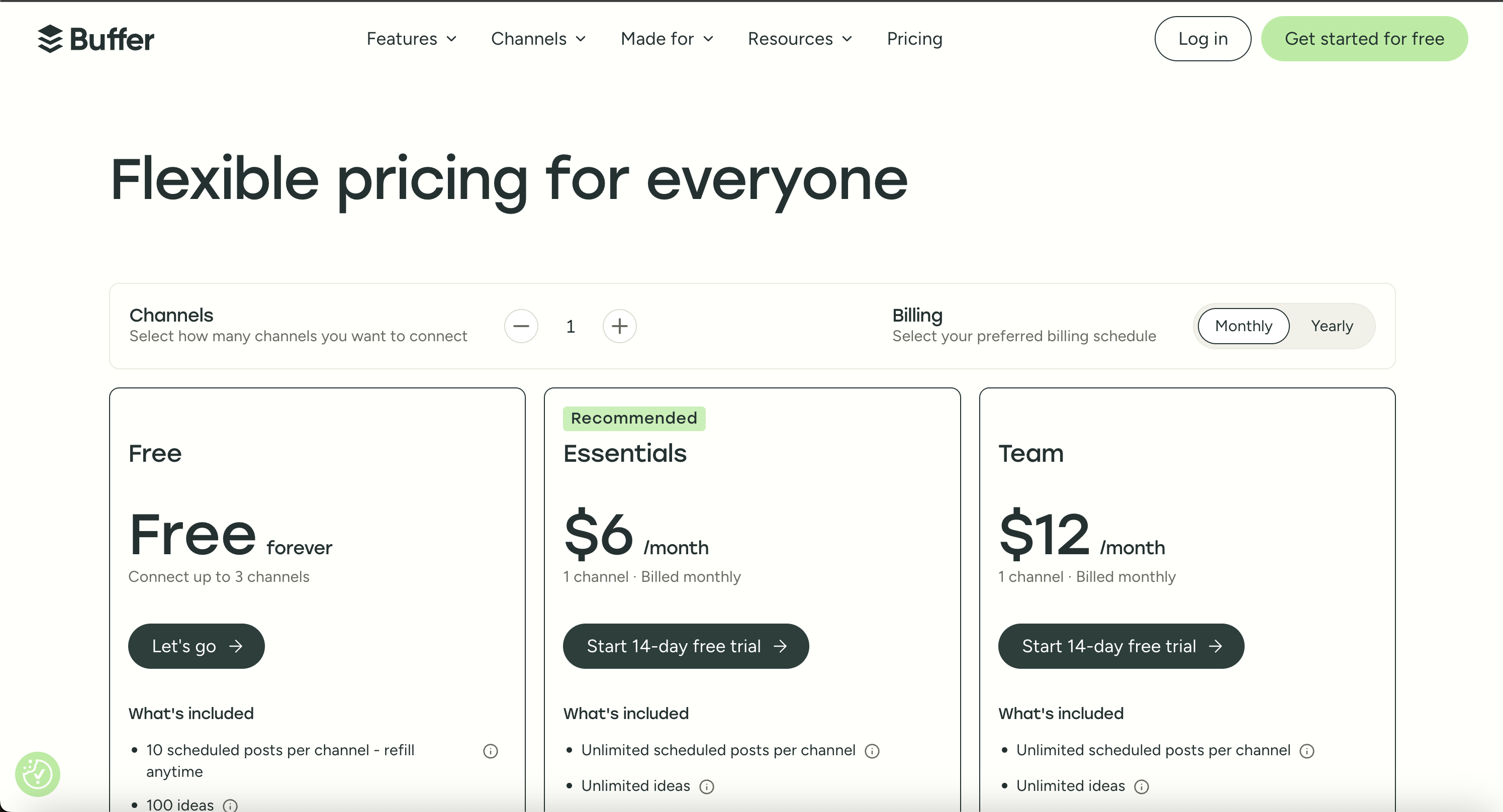
Screenshot evidence — 2026-05-08
Sprout Social
Free plan: No — 30-day trial only
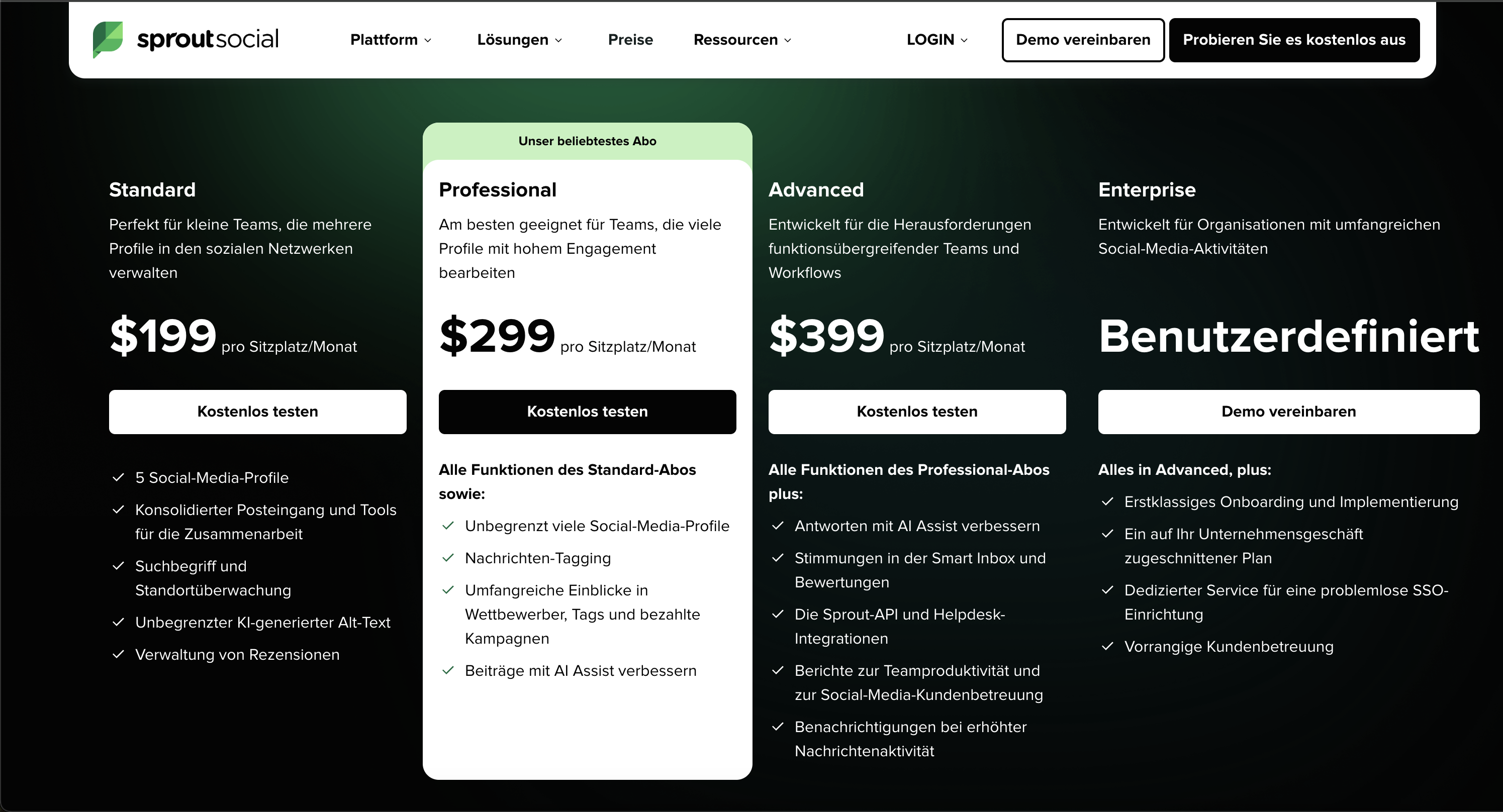
Screenshot evidence — 2026-05-07
Tareno — for comparison
Tareno fills that gap: planning, publishing, approvals, repurposing, and automation for teams that have outgrown Buffer but find Sprout Social overkill and overpriced.
Quick Definition
Buffer and Sprout Social are both social media management platforms, but they optimize for different workflows. This comparison is based on available tool profiles and adjacent comparisons.
How We Evaluated
We analyzed feature profiles, pricing data, and user reviews. This section requires direct testing before publishing.
Where Buffer Wins
- Core strengths based on tool profile
- VERIFY_BEFORE_PUBLISHING
Where Sprout Social Wins
- Core strengths based on tool profile
- VERIFY_BEFORE_PUBLISHING
Pricing Comparison
| Tool | Monthly Start | Free Plan | Verified |
|---|---|---|---|
| Buffer | Check website | Check website | ⚠️ VERIFY_BEFORE_PUBLISHING |
| Sprout Social | Check website | Check website | ⚠️ VERIFY_BEFORE_PUBLISHING |
Pricing changes frequently. Verify directly before publishing.
When Neither Is Ideal
If you need an all-in-one workflow with approvals, repurposing, and automation, neither Buffer nor Sprout Social may be the perfect fit. Consider Tareno as a workflow-first alternative.
Optional Tareno Alternative
Tareno combines visual planning, automated approvals, content repurposing, and analytics in one connected workflow — without the complexity of enterprise tools or the limitations of simple schedulers.
Practical Scenarios
- Scenario 1: [To be filled after testing]
- Scenario 2: [To be filled after testing]
Source Links for Verification
- Buffer: Official pricing · Feature overview
- Sprout Social: [Official pricing](https://www.google.com/search?q=Sprout Social+pricing) · [Feature overview](https://www.google.com/search?q=Sprout Social+features)
- Last reviewed: 2026-05-07 · Status: DERIVED_CONTENT · Action needed: Direct testing and pricing verification
A third option worth considering.
We built Tareno because we got tired of choosing between Buffer's tareno combines scheduling with boards, workflows, repurposing, and analytics instead of treating publishing as an isolated task and Sprout Social's tareno keeps the operational depth (boards, approvals, workflows, analytics) but strips away the enterprise complexity and per-seat pricing that slows smaller teams down. Tareno gives you both in one connected workflow — without the buffer pricing or the sprout social complexity.
Related comparisons


Explore Tareno
Frequently asked questions
Which is better: Buffer or Sprout Social?
After testing both for 30 days, Sprout Social is the better pick for most teams — enterprise teams needing best-in-class analytics and smart inbox. Buffer is still the right choice if solo creators and small brands who want simple per-channel pricing. Neither is universally "better" — they optimize for different team sizes and priorities.
Can I switch between Buffer and Sprout Social easily?
Yes, but expect 1-2 weeks of adjustment. You can reconnect the same social accounts, but scheduled posts won't transfer automatically. The bigger issue is workflow adaptation — switching from Buffer to Sprout Social means adjusting to enterprise complexity. CSV import helps, but you'll need to rebuild your content calendar.
What do real users say about Buffer vs Sprout Social?
Buffer scores 4.3/5 on G2 (1,000+ reviews) and 4.5/5 on Capterra. Sprout Social scores 4.4/5 on G2 (2,000+ reviews) and 4.4/5 on Capterra. The most common praise for Buffer: users love its simplicity. The biggest complaint: No native approval workflows. For Sprout Social: users praise its core strength. The biggest complaint: Enterprise pricing ($249+/seat).
Why is Tareno included in this comparison?
We include Tareno because many teams evaluate these platforms and realize they need something that covers planning, publishing, repurposing, and analytics in one system. Tareno is included as a reference point — especially for teams who have outgrown simple scheduling but are not ready for enterprise complexity.
What is the real cost difference at scale?
At 5 channels and 3 team members: Buffer costs approximately $90/mo. Sprout Social costs approximately $747/mo. Tareno Pro is €23/mo for 5 team members and 15 channels. The gap widens significantly as you scale.
Does Buffer or Sprout Social have a free plan?
Buffer: Yes — 3 channels, basic scheduling. Sprout Social: No — 30-day trial only. Tareno: Yes — 2 channels, 15 posts, no credit card required.
Sources and references
Sprout Social
Pricing verified: 2026-05-02 (A) · 2026-05-02 (B). Prices change frequently — verify directly before purchasing.