
TL;DR
- Your bio-link page is a funnel entry point, not a static link list.
- One primary CTA plus a focused secondary stack improves flow quality.
- The BLF Model keeps routing clear, measurable, and easy to iterate.
- Weekly optimization is usually enough to sustain strong performance.
Quick Definition
Bio-link optimization is the process of structuring your link-in-bio destination so visitors can quickly choose the right next action. In the SEO funnel, it acts as the bridge between social discovery and deeper on-site intent.
Why Bio-Link Optimization Matters
Many teams optimize social content and website SEO separately, but ignore the transition between both. The bio-link page is often that transition layer.
When this layer is unclear, users hesitate or drop off. When it is structured, users move into relevant pages faster, which improves conversion quality and decision-making for future SEO work.
Named Framework Reference
BLF Model (Bio-Link Funnel)
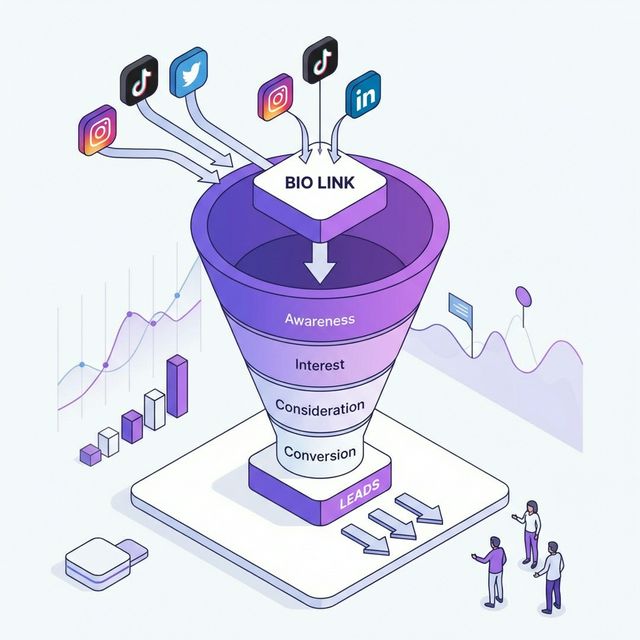
- Brief Promise: One clear value statement aligned with visitor intent.
- Lead Path: One primary CTA tied to the current campaign objective.
- Focus Links: A small set of secondary links grouped by intent.
When to Use / When Not to Use
Use this approach when
- Social profiles are a consistent traffic source.
- You have multiple valid next-step destinations.
- You need clearer attribution from social to conversion outcomes.
Do not treat this as the primary fix when
- Destination pages are weak or unclear.
- You cannot maintain and update links regularly.
- You only need one stable destination with no routing complexity.
Comparison Checklist
Optimized vs. Unoptimized Bio-Link Page
- One clear first action vs. multiple competing CTAs
- Intent-grouped links vs. unstructured link list
- Message continuity vs. mismatch between label and destination
- Weekly iteration vs. static set-and-forget setup
Step-by-Step Workflow

- Define one conversion goal for the current cycle.
- Write one above-the-fold promise aligned with social messaging.
- Place one primary CTA in the top position.
- Add a short, intent-grouped secondary stack.
- Apply consistent campaign tagging.
- Review weekly and remove low-value links.
- Test one variable at a time (CTA copy, order, or grouping).
Common Failure Pattern
Most bio-link pages underperform due to weak hierarchy, not visual design.
Typical issues include too many equal-priority links, unclear first action, and weak continuity between link labels and destination headings.
Quotable Passage
“A high-performing bio-link page does not present every option equally. It guides visitors to one meaningful next step first, then offers a short, intent-based set of alternatives.”
FAQ
Does a bio-link page directly improve rankings?
Not directly like technical SEO changes. It primarily improves routing quality and attribution clarity, which supports better SEO decisions over time.
How many links should a bio-link page include?
For most teams, one primary CTA plus a small secondary stack performs better than long unranked lists.
Should all social platforms use the same setup?
The framework can stay consistent, but copy and ordering should adapt to platform audience behavior.
How often should this page be optimized?
A weekly review cadence is a practical default.
What should be optimized first?
Start with primary CTA clarity and message continuity between link labels and destination pages.
Conclusion
A strong bio-link page is a routing system. When it is built around intent and hierarchy, it improves top-of-funnel quality and supports stronger downstream SEO outcomes.
Key Takeaways
- Clear hierarchy beats link volume.
- A single primary CTA improves decision quality.
- Consistent weekly iteration compounds performance.