TL;DR
Batching works when you batch by cognitive mode, not by random tasks.
One-day monthly batching is realistic with planning, production, and review separation.
A hybrid model (batched core + live slots) keeps relevance high.
Structured workflow beats motivation-based posting.
Quick Definition
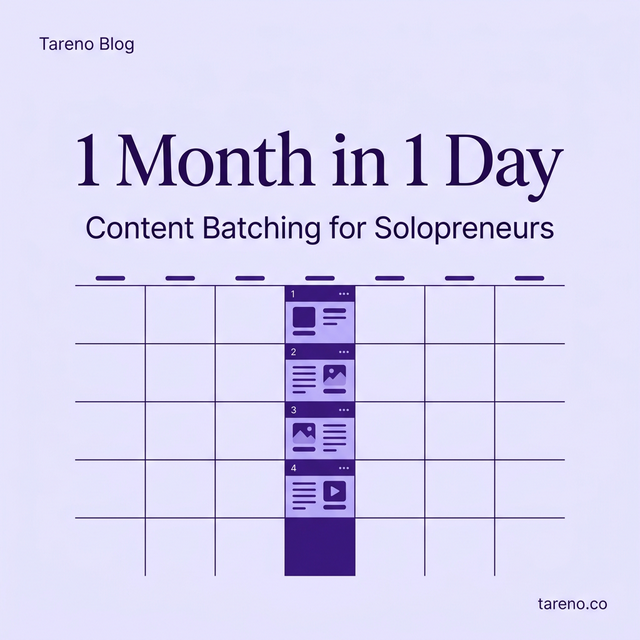
Content batching is the structured production of multiple content assets in one focused session, then distributing them over time via a publishing calendar. For solopreneurs, the purpose is consistency with lower stress—not maximum output at any cost.
The Real Bottleneck: Fragmentation, Not Creativity
Most solo founders and creators don’t fail because they lack ideas. They fail because they produce in a fragmented way: write a post between calls, design after dinner, schedule in a rush, then miss the next day due to client work.
Counterargument: “Daily posting keeps content fresh and authentic.”
Trade-off: daily spontaneity can be useful, but without protected production blocks it usually reduces consistency and quality. A brand that appears randomly loses trust faster than a brand that publishes predictably.
Edge case: trend-driven niches may still need daily reactive posting, but even there, the foundational content system should be batched.
Concrete scenario: a freelancer spends 90 minutes daily trying to post and still misses half the week. After moving to one monthly batching day, output stabilizes and strategy quality improves.
Common misconception: batching creates robotic content. Bad batching creates robotic content. Good batching creates reliable strategic bandwidth.
Takeaway: Inconsistent publishing is usually an operations failure.
Takeaway: Batching should reduce chaos, not creativity.
The BLOC Framework
Use BLOC for one-day monthly batching:
B — Blueprint: lock monthly themes and weekly intent.
L — Library: prepare examples, references, and reusable hooks.
O — Output Sprint: produce in focused blocks by format.
C — Calendar Control: schedule, QA, and reserve live slots.
Counterargument: “Frameworks are too rigid for creative work.”
Trade-off: rigidity can be harmful if absolute, but light structure increases output reliability and reduces decision fatigue.
Edge case: creator-led brands with high energy variance can split BLOC into two half-days while preserving sequence.
Concrete scenario: creator uses Blueprint for four pillars, builds a hook library, writes scripts in one sprint, and schedules all core posts in a queue.
Common misconception: batching starts with writing. It starts with planning clarity.
Takeaway: Sequence beats intensity.
Takeaway: Better preparation shortens production time.
What to Batch (and What to Keep Live)
Batch aggressively
educational pillar posts
reusable CTA variants
carousel/story structures
long-form outlines and scripts
Keep live or semi-live
trend responses
community replies
launch updates with changing context
Counterargument: “If batching is good, full automation is better.”
Trade-off: fully pre-scheduled systems can drift from live context. Hybrid systems are more resilient.
Edge case: launch weeks may require temporary live-heavy ratio.
Concrete scenario: team batches 80% core content and keeps 20% reactive slots. Result: stable cadence + contextual relevance.
Common misconception: hybrid models are less efficient. They are often more sustainable.
Takeaway: Batch foundations, not everything.
Takeaway: Reserve flexibility as a deliberate design choice.
Tool Evaluation Rule (3 Categories × 3 Criteria)
Category 1: Planning
content calendar clarity
pillar mapping support
ideation capture speed
Category 2: Production
Draft -> Review -> Scheduled support
template reuse capability
version tracking
Category 3: Distribution
Publishing Queue reliability
Approval status visibility
multi-channel scheduling consistency
Takeaway: Tools should support your operating model, not replace it.
One-Day Execution Blueprint
Block 1 — Strategy lock (60 min)
define monthly goals
map weekly themes
assign channel roles
Block 2 — Hook and angle sprint (90 min)
create multiple hook options per theme
pre-select strong openings
Block 3 — Core drafting (180 min)
write in format batches
avoid platform switching
Block 4 — Repurposing (90 min)
adapt one source idea into multi-channel variants
Block 5 — QA and scheduling (90 min)
claim check
clarity pass
queue scheduling + live slots
Takeaway: Timeboxing reduces overthinking and protects output.
Takeaway: QA before scheduling prevents rework loops.
Common Failure Patterns
Unrealistic monthly targets
No source library before batching day
No review stage
No reactive capacity
No monthly retrospective
Takeaway: Most batching failures happen before writing starts.
Free Tools (Quick Links)
Batch Day Planner — Build a realistic one-day monthly content plan.
Hook Variation Generator — Generate multiple opening angles fast.
Repurposing Matrix Template — Convert one source into channel variants.
Publishing Queue Checklist — Validate scheduling readiness before publish.
FAQ
Is one-day batching realistic for solo teams?
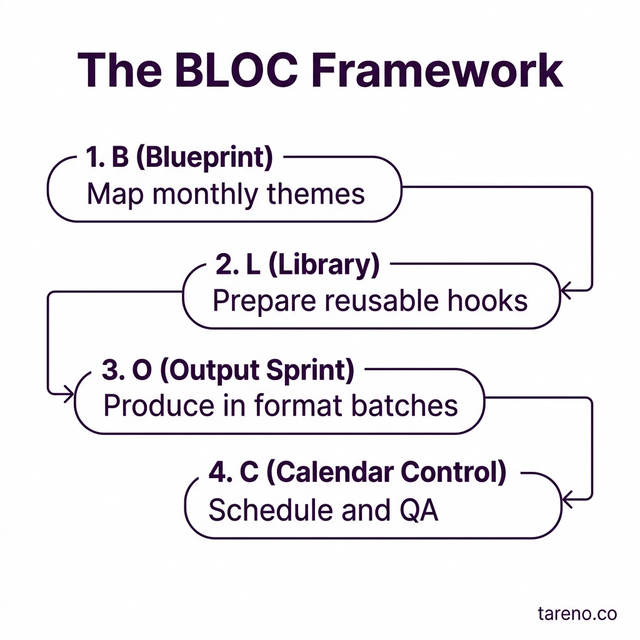
The BLOC Framework Structure
Yes, with realistic scope and strict sequencing.
How many posts should be batched?
Enough to protect consistency without lowering quality.
Should all content be pre-scheduled?
No. Keep a portion for real-time relevance.
What metric matters first?
Publishing consistency and reduced missed-post rate.
Why Tareno is the Ultimate Engine for the BLOC Framework
If you're adopting the BLOC Framework (Blueprint, Library, Output, Calendar), you quickly realize that jumping between five different tools—Notion for ideas, Claude for drafting, Canva for visuals, and standard schedulers for distribution—creates exactly the kind of fragmentation batching is meant to prevent.
This is where Tareno shines for Solopreneurs:
Tareno Ideation Board
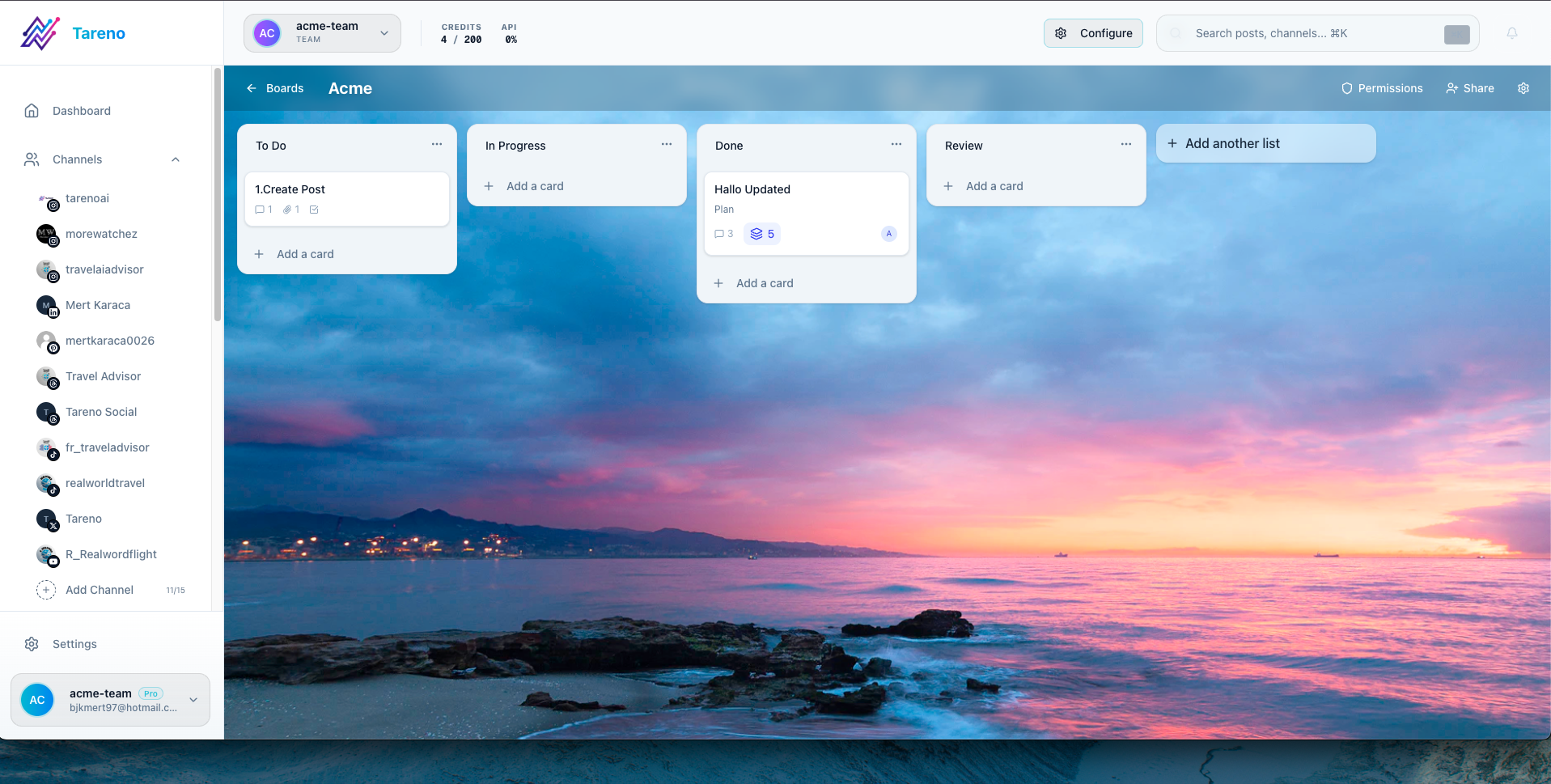
The "Library" is built-in: Tareno's Ideation Board acts as your central repository, preventing you from losing hooks or ideas in scattered docs.
The "Output Sprint" is accelerated: With specialized AI agents that understand platform logic (from LinkedIn thought leadership to Instagram reels), you can scale your drafting process without losing your unique voice.
The "Calendar Control" is seamless: Going straight from AI generation to the built-in Post Composer means you schedule directly where you create.
By bringing generation and scheduling into a single unified workspace, Tareno cuts the "tool-switching tax" to zero, turning a grueling one-day sprint into an effortless afternoon.
Conclusion
Content batching is a practical operating system for solopreneurs who want consistency without daily content stress. The goal is not more content—it is better rhythm.
Key Takeaways
Batch by cognitive mode.
Use BLOC for predictable quality.
Keep hybrid flexibility.
Protect output with QA and review loops.
Audio Version
Audio Version