
TL;DR
Omnipresence works when every channel has a strategic role, not when content is copied everywhere.
Repurposing quality depends on adaptation depth, not output volume.
Governance is the protection layer that keeps scale from turning into brand noise.
Quick Definition
Omnipresence strategy is selective, role-based visibility across chosen channels through intentional repurposing of one core idea. It succeeds when adaptation changes decision utility per platform rather than duplicating format.
Why Omnipresence Matters in Fragmented Attention Markets
Audience attention is now distributed across multiple environments, each with different intent patterns. A single-platform strategy can still work, but it increases concentration risk: one algorithmic shift or relevance drop can disproportionately impact visibility.
Counterargument: deep focus on one channel often creates stronger early compounding than spreading across several channels. That is true in early-stage positioning when message clarity is still weak. The trade-off is fragility: if one channel underperforms, your entire attention engine slows.
Edge case: highly specialized B2B brands with long buying cycles may get better outcomes from two tightly managed channels than from broad expansion. The decision boundary is not channel count; it is role precision.
Concrete scenario: a niche SaaS brand uses LinkedIn for authority, Instagram for familiarity, and email for conversion depth. One weekly insight is repurposed differently for each role rather than cloned.
Common misconception: omnipresence means being active everywhere. In reality, it means being consistently relevant where audience decisions happen.
ROLE Matrix Framework
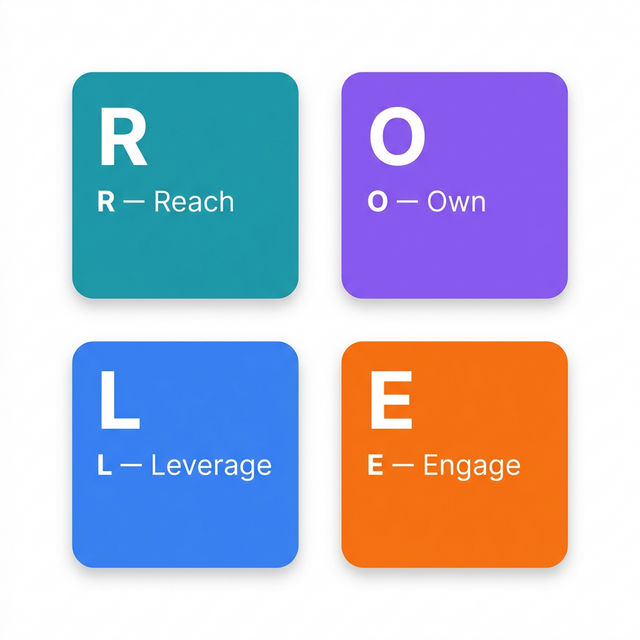
The ROLE Matrix framework: four platform archetypes for an effective omnipresence content strategy.
The ROLE Matrix prevents repurposing from becoming low-quality duplication.
R — Role
Define one primary purpose per platform: discovery, authority, trust, or conversion support.
O — Original Core Asset
Start from one high-quality source (pillar article, webinar synthesis, research memo, founder essay).
L — Level of Adaptation
Adapt according to channel intent, not merely format. Discovery channels require clarity and hook compression; authority channels require structure, nuance, and argument integrity.
E — Evaluation Cadence
Run weekly performance and quality reviews to retain high-signal transformations and stop weak ones.
High-performing repurposing systems optimize relevance per channel role, not mere distribution volume.
Counterargument: frameworks can over-structure and slow creative speed. Trade-off: some spontaneity is reduced, but strategic coherence increases. For trend-heavy brands, a fixed reactive content slot can preserve agility.
Edge case: creator-led brands with strong personality gravity can tolerate less structural adaptation, but only while trust remains high.
Concrete scenario: one long-form analysis becomes a concise thread, a narrative carousel, and a decision checklist post. Same thesis, different cognitive utility.
Common misconception: changing headline and image is adaptation. Real adaptation changes user outcome for that channel.
Why Repurposing Fails in Real Teams
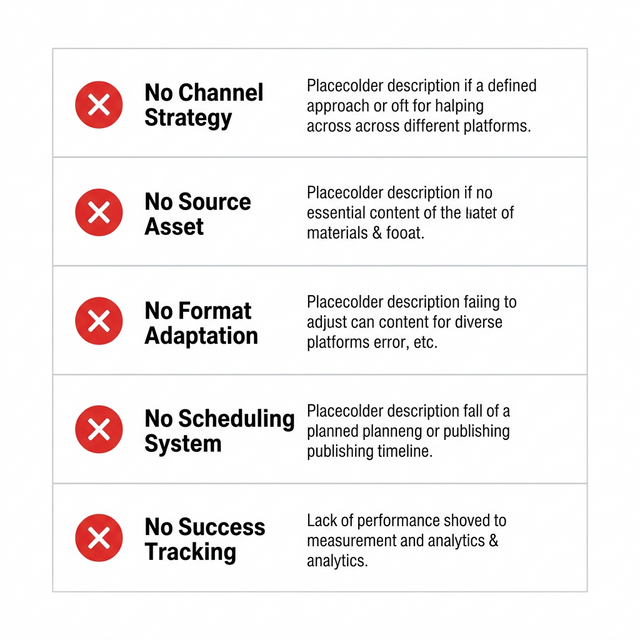
Five common reasons content repurposing fails — and why a centralized system prevents each one.
Most teams do not fail because they lack topics. They fail because process design encourages quantity over adaptation quality.
Failure pattern 1: format cloning.
Failure pattern 2: intent mismatch.
Failure pattern 3: ownership ambiguity.
Counterargument: in fast campaign windows, speed can matter more than adaptation depth. That is valid short term. The trade-off is long-term brand fatigue if low-context reuse becomes habitual.
Edge case: event-driven brands can temporarily prioritize speed, but need post-campaign quality normalization.
Concrete scenario: a team publishes one unchanged post across four channels for a month, sees flat outcomes, then blames topic saturation. Actual root cause: no channel-specific value translation.
Common misconception: repurposing means “less effort for same outcome.” The stronger version is “different effort for better distribution economics.”
Tool Evaluation Rule (3 Categories × 3 Criteria)
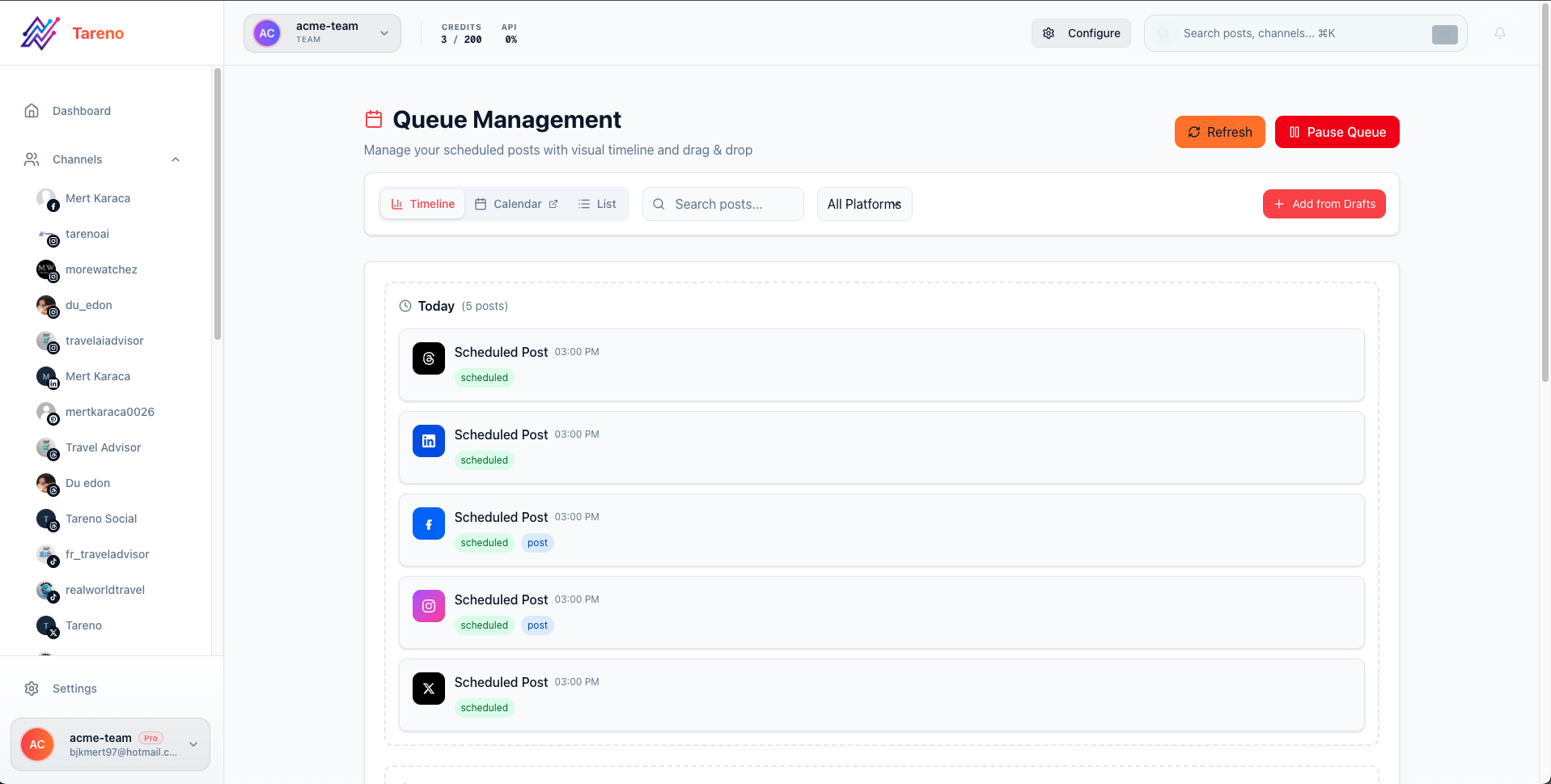
Tareno's publishing queue: manage multi-platform repurposing workflows in one centralized calendar view.
Category 1: Planning & Scheduling
role-based calendar clarity
Publishing Queue reliability
timeline visibility by channel
Category 2: Adaptation Workflow
Draft -> Review -> Scheduled flow support
Approval status traceability
version control for channel variants
Category 3: Governance & Analytics
role-level outcome visibility
weekly review usability
decision log accountability
Channel Role Architecture
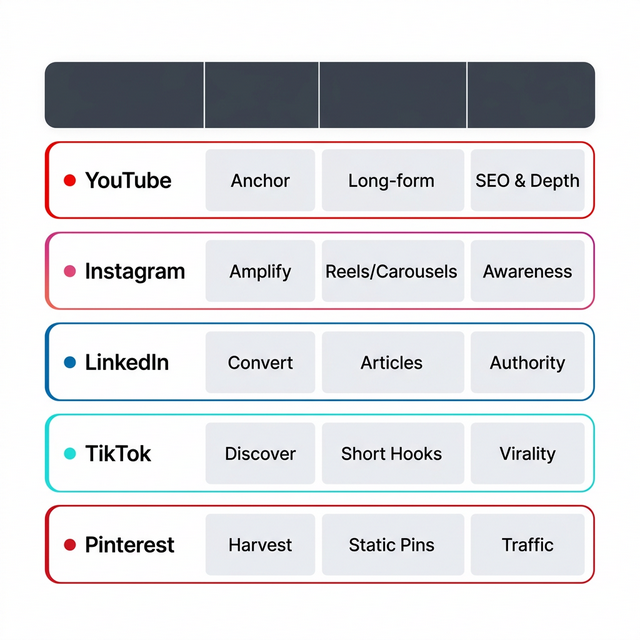
Channel Role Architecture: how five platforms serve distinct functions in a repurposing-first content system.
A high-performing omnipresence system uses distinct role logic:
Discovery channel
Authority channel
Conversion support channel
Counterargument: one channel can technically do all three roles. Trade-off: possible in theory, but operationally harder at scale.
Edge case: very small operations may combine authority and conversion support in one channel temporarily.
Concrete scenario: founder-led brand uses short insights for discovery and weekly deep posts for authority, while email captures conversion support.
Common misconception: channel strategy equals content format strategy. It is decision-stage strategy.
Implementation Blueprint (Solo + Team)
choose 2–3 channels with distinct roles
define one weekly core asset format
create adaptation rules per role
assign owner + reviewer responsibilities
execute fixed cadence plus one reactive slot
run weekly keep/improve/stop review
run monthly role recalibration
Counterargument: this is too heavy for lean teams. Trade-off: setup takes effort, but execution becomes faster and less chaotic over time.
Edge case: solo operators can use delayed self-review to simulate reviewer discipline.
Concrete scenario: one consultant turns a weekly client pattern memo into three role-specific assets and removes the weakest variant after each review cycle.
Common misconception: systems reduce creativity. Strong systems preserve creativity by reducing repetitive operational decisions.
Governance and Risk Control
Governance ensures omnipresence scales quality rather than noise.
Minimum stack:
adaptation checklist
ownership map
escalation trigger
weekly quality review
monthly role recalibration
Counterargument: governance can become bureaucracy. Trade-off: over-control slows speed; under-control increases drift.
Edge case: during product launches, teams can use temporary governance shortcuts but should restore full controls after campaign peak.
Concrete scenario: team identifies repeated low-signal adaptations in one channel, redefines role expectations, and reallocates output toward high-yield transformations.
Common misconception: consistency alone builds omnipresence. Consistency without governance scales mistakes.
FAQ
Is posting the same content everywhere a good omnipresence strategy?
Usually no. It creates visibility surface but low contextual relevance.
How much adaptation is enough?
Enough to change channel-specific decision utility, not just headline and format.
How many channels should small teams operate?
Two to three role-distinct channels are often stronger than broad shallow coverage.
Can repurposing hurt trust?
Yes, if audiences repeatedly see low-effort duplicates.
What should teams review weekly?
Role fit, adaptation quality, execution consistency, and weak transformation patterns.
What is the fastest way to improve outcomes?
Improve adaptation standards and remove low-signal channel variants quickly.
Conclusion
Omnipresence becomes a strategic asset only when repurposing is role-based, governed, and continuously evaluated. Teams that operationalize adaptation quality build resilient visibility systems that compound over time.
Key Takeaways
Channel roles matter more than channel count.
Adaptation depth matters more than output volume.
Governance is the long-term quality safeguard.