
TL;DR
Threads is no longer a hype channel. It is a fit channel.
Brands should decide based on strategic role, not trend pressure.
A structured 30-day validation cycle prevents wasted effort.
Threads can be valuable as a conversation and narrative-testing layer.
For many brands, it should complement—not replace—LinkedIn, X, or owned media.
Quick Definition
Threads is a conversational social platform where brands can build visibility through consistent short-form perspective, community interaction, and narrative iteration. One year later, its value depends less on platform novelty and more on whether your brand has the operating model and voice to use it effectively.
Why This Question Matters Now
A year ago, most brand conversations about Threads were emotional: either “you must be early” or “it’s just another temporary spike.” Today, that lens is outdated. The core question is operational: does Threads improve your channel portfolio outcomes relative to the effort it requires?
That shift matters because many teams are now over-allocated. They are producing for multiple platforms, maintaining email, creating video, handling community messages, and trying to preserve quality at the same time. In that environment, every additional platform must have a clear strategic job.
Counterargument: “Even if Threads is uncertain, posting there costs little, so why not keep it active?”
Trade-off: low-effort presence can still carry hidden costs—context switching, editorial dilution, and weak signal quality. If your Threads activity pulls attention away from higher-yield channels, “cheap participation” becomes expensive.
Edge case: founder-led brands with rapid idea velocity may gain unique value from Threads because they can publish and iterate naturally without heavy production requirements.
Concrete scenario: a small B2B team posts irregularly on five channels and sees flat performance across all of them. They cut two low-fit channels, define Threads as “narrative testbed,” and use validated angles for LinkedIn long-form and newsletter essays. Performance improves not because Threads exploded, but because the channel stack became coherent.
Common misconception: platform worth is universal. In practice, platform worth is always contextual.
Takeaway: This is no longer a platform-timing question; it is a portfolio-fit question.
Takeaway: Threads can be strategically useful, but only with a clear role and execution discipline.
Threads After Year One: What Actually Changed
The first phase of any new platform rewards novelty and curiosity. The second phase rewards consistency, message clarity, and interaction quality. Threads has moved into that second phase.
What changed in practical terms:
Low-effort novelty posts lost relative advantage.
Conversational brand voice became more important than announcement-style posting.
Teams that treat Threads as an integrated channel (not an isolated feed) tend to extract more value.
Counterargument: “If novelty is gone, opportunity is gone.”
Trade-off: yes, easy wins are fewer. But lower novelty also reduces noise from opportunistic participation, which can create better long-term conditions for disciplined brands.
Edge case: brands in highly visual categories may find Threads less central than platforms optimized for visual storytelling—unless they use Threads for positioning narratives and audience framing rather than final creative expression.
Concrete scenario: a brand that previously posted product promos switches to opinion-led posts about industry trade-offs, replies consistently, and maps audience reactions to future content themes. Threads becomes a strategic listening + framing channel.
Common misconception: fewer viral spikes means the platform is irrelevant. Stable channels often produce strategic value through compounding trust, not through constant spikes.
Takeaway: Threads matured from hype channel to execution-quality channel.
Takeaway: Maturity increases the value of disciplined strategy.
The FIT Lens Framework (Decision Model)
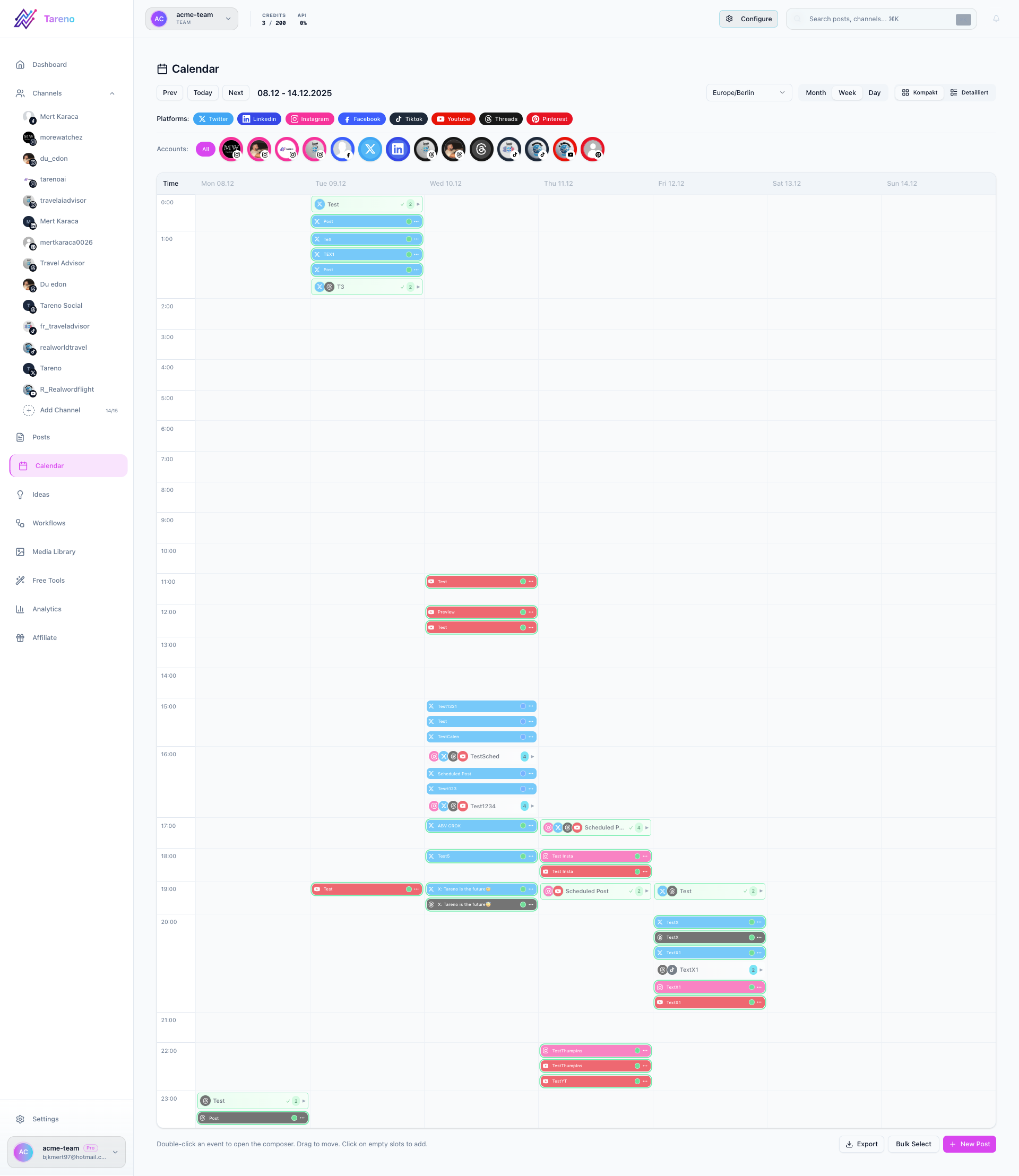
Tareno's multi-platform calendar: plan and schedule Threads content alongside every major social channel in a single week view.
If you run Threads as a real channel, tooling should support strategy—not just scheduling.
Category 1: Scheduling & Workflow Tools
Evaluate by:
Publishing Queue reliability
calendar visibility across channels
Draft -> Review -> Scheduled flow quality
Category 2: Conversation Operations Tools
Evaluate by:
response workflow clarity
context continuity for threads and replies
prioritization support for high-signal conversations
Category 3: Review & Decision Tools
Evaluate by:
trend signal readability
weekly review usability
effort-to-impact traceability
Counterargument: “Threads is lightweight; advanced workflow is unnecessary.”
Trade-off: lightweight execution is fine at small scale. But once multiple contributors or channels are involved, missing workflow visibility creates drift and duplicated effort.
Edge case: solo operators can run minimal tooling if they maintain strict review habits and documented channel intent.
Concrete scenario: a team introduces explicit Approval status and weekly decision logs. They stop publishing low-signal post types and reallocate effort to formats that trigger useful discussions.
Common misconception: tools create strategy. Tools only make strategy executable.
Takeaway: Choose tools that preserve role logic and review discipline.
Takeaway: Operational visibility is a quality multiplier.
Which Brands Should Invest More in Threads?
Strong-fit profiles
Founder-led brands with strong perspective cadence
Education-first brands that can sustain short insight loops
Community-oriented brands with active response culture
Lower-fit profiles
Promotion-heavy brands with low conversational value
Teams with weak interaction capacity
Organizations without clear editorial ownership
Counterargument: “Any brand can succeed with enough persistence.”
Trade-off: persistence without fit can become expensive repetition. Effort should follow evidence, not hope.
Edge case: brands with low initial fit can improve through capability-building—especially by strengthening voice clarity and interaction workflows.
Concrete scenario: a product-heavy brand initially underperforms. They shift from promo posts to “decision myths” and “implementation mistakes” content, then improve discussion quality and downstream content performance.
Common misconception: platform fit is fixed. Fit can be improved, but it requires intentional operating changes.
Takeaway: Fit is not destiny, but ignoring fit is costly.
Takeaway: Threads rewards brands that can sustain perspective + interaction.
30-Day Validation Blueprint (Authority Mode)
Use this to make a decision with discipline.
Week 1: Role Definition
Define Threads role in your portfolio (testing, conversation, authority support, etc.)
Set success and failure criteria
Clarify ownership and review cadence
Week 2: Structured Publishing
Publish a focused post series (theme-based)
Maintain consistent format logic
Start reply workflows with defined response windows
Week 3: Interaction Quality Review
Review which posts generate meaningful discussion
Identify low-signal patterns and remove them
Compare effort required vs value created
Week 4: Decision Cycle
Classify outcome: scale, maintain, reposition, or exit
Document what worked and what failed
Integrate lessons into broader channel strategy
Counterargument: “30 days is too short for platform truth.”
Trade-off: true long-term outcomes need longer horizons. But a 30-day cycle is enough to detect whether basic fit exists.
Edge case: low-frequency industries may need longer validation windows due to slower audience response rhythms.
Concrete scenario: a team finishes 30 days with moderate engagement but high strategic insight. They keep Threads as idea-lab channel instead of forcing it as direct conversion channel.
Common misconception: all channels must prove direct revenue in first cycles. Some channels create narrative and trust assets that convert elsewhere.
Takeaway: Entry criteria and exit criteria are equally important.
Takeaway: Validation should guide allocation, not justify sunk costs.
Common Failure Patterns (and Fixes)
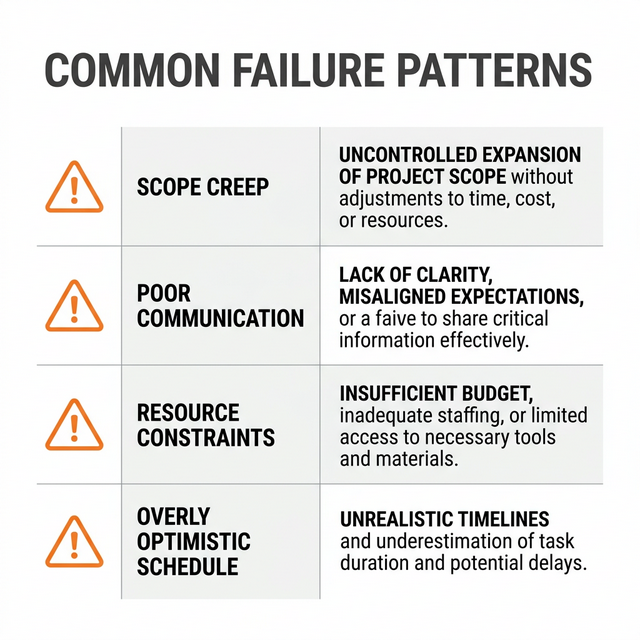
Four common failure patterns when brands adopt Threads — and how to fix each one before they cost you momentum.
Failure 1: Announcement feed behavior
Problem: brand posts updates without perspective value.
Fix: switch to opinion + interpretation + implication format.
Failure 2: Cadence without conversation
Problem: posts are frequent, responses are weak.
Fix: add dedicated response blocks and conversation ownership.
Failure 3: No role boundary
Problem: Threads duplicates what LinkedIn already does.
Fix: define unique role (e.g., idea testing, live narrative shaping).
Failure 4: Effort creep
Problem: team adds Threads work without removing low-value work elsewhere.
Fix: enforce portfolio trade-offs and explicit effort caps.
Failure 5: Misreading metrics
Problem: decisions based only on superficial reach spikes.
Fix: add quality metrics (discussion relevance, reuse potential, strategic signal quality).
Counterargument: “These controls slow content velocity.”
Trade-off: yes, short-term velocity may drop slightly. Long-term signal quality and strategic coherence usually improve.
Edge case: campaign moments may justify temporary looser controls, but baseline governance should return afterward.
Concrete scenario: a team cuts 30% of post volume, improves post quality, and sees stronger cross-channel reuse value.
Common misconception: more posts automatically produce more strategic value.
Takeaway: Better decisions often come from reducing low-yield activity.
Takeaway: Threads performance is a function of channel discipline.
When to Use / When Not to Use Threads
Use Threads when:
you have a clear conversational point of view
you can sustain consistent interaction quality
you can map Threads role to broader channel objectives
Do not prioritize Threads when:
core positioning is still unclear
interaction capacity is near zero
current channel portfolio is already unstable
Decision boundary: if Threads effort repeatedly weakens stronger channels, scale down immediately.
Takeaway: Channel expansion should never degrade portfolio health.
Takeaway: Threads should serve strategy, not distract from it.
FAQ
Is Threads still worth it for brands in 2026?
For the right brand profile and operating model, yes. For others, it may remain low priority.
Can Threads replace LinkedIn or X?
Usually no. It tends to work best as a complementary role within a channel system.
How often should brands post on Threads?
Consistency matters more than extremes. Sustainable cadence with meaningful interaction is the target.
What is the most common reason brands fail on Threads?
Role confusion combined with weak interaction discipline.
Should small teams ignore Threads?
Not necessarily. Small teams can win if they define a narrow role and run a controlled validation cycle.
What should determine scale-up decisions?
Evidence of fit: sustainable throughput, useful conversations, and strategic contribution to portfolio outcomes.
Conclusion
Threads one year later is neither a guaranteed growth lever nor a wasted effort by default. It is a strategic option that becomes valuable when channel role, operational capability, and governance are aligned.
Brands that treat Threads as part of a coherent portfolio—rather than as a hype reaction—can extract meaningful long-term value. Brands that chase surface activity without role clarity usually burn effort with limited strategic return.
Key Takeaways
Threads is a fit channel, not a default channel.
Use FIT Lens to decide with operational honesty.
Run a 30-day validation with explicit scale/exit rules.
Protect portfolio coherence through role boundaries.
Optimize for strategic signal quality, not activity volume.