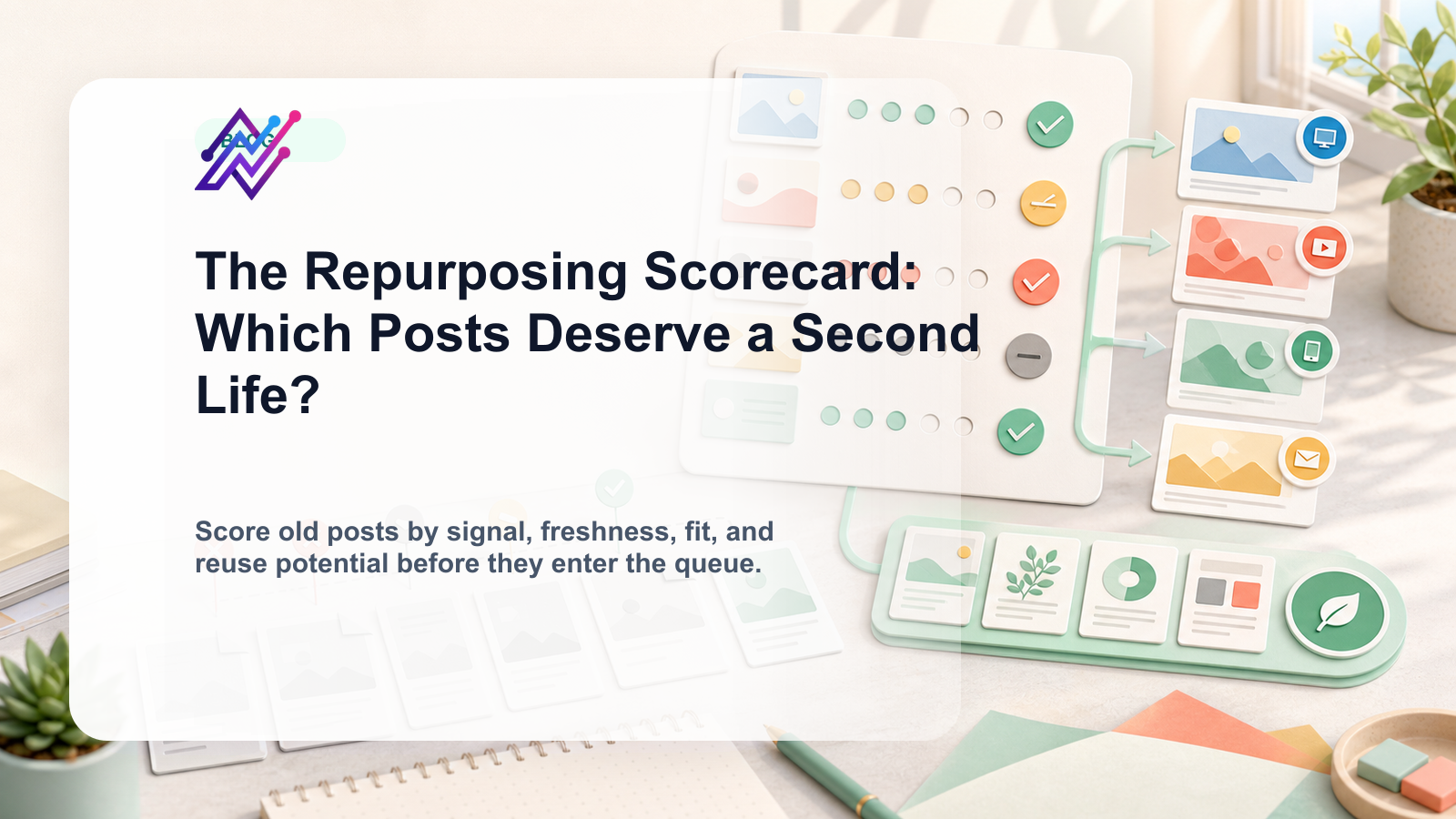
Not every old post deserves to be republished. Some posts were timely, weak, outdated, tied to a trend, or risky to reuse without updates.
Other posts are assets. They proved audience interest, still match the business, and can become refreshed content for another platform, format, or campaign.
A repurposing scorecard gives teams a repeatable way to decide what deserves a second life. The workflow is simple: review the signal, score the post, choose the action, rewrite for the next channel, approve the update, schedule it, and measure again.
TL;DR
Score each post across six areas:
performance signal
evergreen value
audience relevance
business relevance
freshness risk
Then choose one action:
repurpose now
refresh and retry
update before reuse
save for later
archive
The key rule:
Repurpose posts with both performance signal and future relevance.
A post can perform well and still be a bad candidate if it is outdated, risky, or too context-specific.
Why a scorecard is better than guessing
Without a scorecard, teams make emotional decisions.
They reuse posts they personally liked.
They ignore posts that quietly performed well.
They overvalue reach.
They forget saves, clicks, comments, and watch time.
They reuse outdated claims.
They fail to adapt content for new platforms.
A scorecard creates a repeatable decision process.
It helps creators, agencies, SaaS teams, and content teams choose what should enter the repurposing queue.
The six scoring categories
Use a 1 to 5 score for each category.
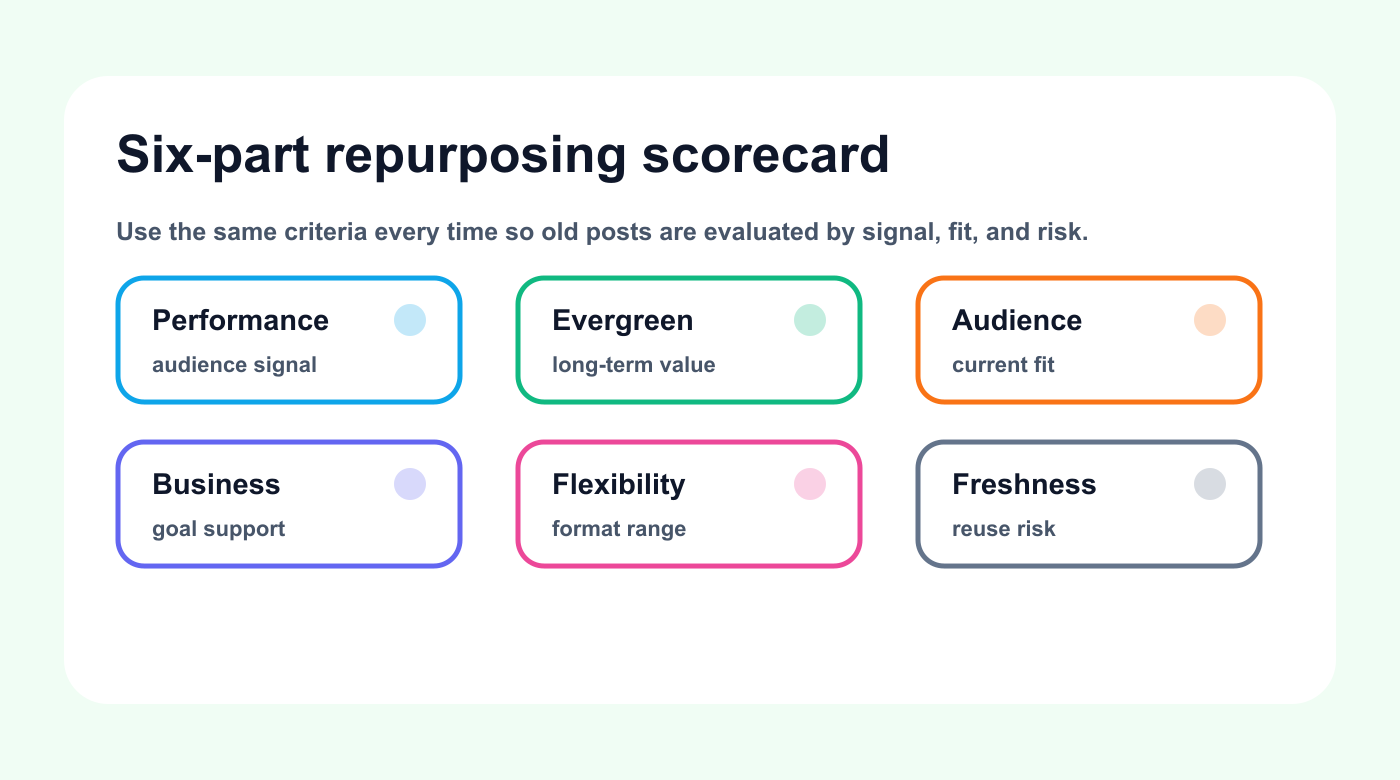
The scorecard keeps reuse decisions consistent instead of emotional.
CategoryWhat it measuresPerformance signalDid the post prove audience interest?Evergreen valueWill the idea stay useful?Audience relevanceDoes it still match the target audience?Business relevanceDoes it support a goal?Platform flexibilityCan it become another format?Freshness riskIs it safe to reuse without major updates?
Maximum score: 30.
You do not need perfect scoring.
You need consistent scoring.
Category 1: Performance signal
Score based on how the post performed relative to your baseline.

Performance signals are strongest when saves, clicks, comments, and conversions are reviewed together.
Signals include:
saves
shares
comments
clicks
watch time
completion rate
profile visits
conversions
qualified replies
strong audience questions
Score guide:
ScoreMeaning1No clear signal2Slightly below average3Average or mixed4Above average5Clear outlier
Do not use reach alone.
A post with modest reach but strong saves can be a great repurposing candidate.
Category 2: Evergreen value
Evergreen value measures whether the idea stays useful over time.
High evergreen value:
tutorials
workflows
checklists
mistakes
templates
frameworks
FAQs
recurring objections
customer questions
Low evergreen value:
one-time announcements
temporary offers
trend reactions
outdated platform news
event-specific content
Score guide:
ScoreMeaning1Fully time-sensitive2Mostly temporary3Useful for a short period4Mostly evergreen5Long-term reusable
Evergreen value is what makes repurposing worth it.
Category 3: Audience relevance
A post may have performed well months ago but no longer match your audience.
Ask:
Do we still serve this audience?
Is this still a priority segment?
Does the topic match current positioning?
Would this help today’s buyer, client, or creator?
Does it support the content strategy now?
Score guide:
ScoreMeaning1No longer relevant2Weak fit3Somewhat relevant4Strong fit5Perfect audience fit
This prevents old content from pulling the brand in the wrong direction.
Category 4: Business relevance
Repurposing should support a goal.
Goals can include:
signups
demos
traffic
client education
creator engagement
product adoption
onboarding
retention
brand trust
SEO/GEO support
campaign support
Score guide:
ScoreMeaning1No business value2Weak connection3Indirect value4Strong value5Direct value
A funny post might have performed well but may not deserve repurposing if it has no strategic value.
Category 5: Platform flexibility
Some posts can travel across platforms easily.
A strong idea can become:
LinkedIn post
Threads post
TikTok script
Instagram carousel
Pinterest pin
YouTube Short
blog section
email
sales asset
Score guide:
ScoreMeaning1Only works in original context2Hard to adapt3One or two possible adaptations4Several formats possible5Strong multi-platform potential
High platform flexibility makes repurposing more valuable.
Category 6: Freshness risk
Freshness risk measures how much review is needed before reuse.
High-risk content includes:
pricing
product claims
competitor mentions
old screenshots
legal-sensitive content
sponsor/client content
old platform advice
expired offers
time-specific stats
Score this positively: 5 means low risk.
ScoreMeaning1High risk, major update needed2Needs review before reuse3Some freshness check needed4Low risk5Safe evergreen content
Do not skip this category.
It protects the repurposing queue.
Score interpretation
Use this table.
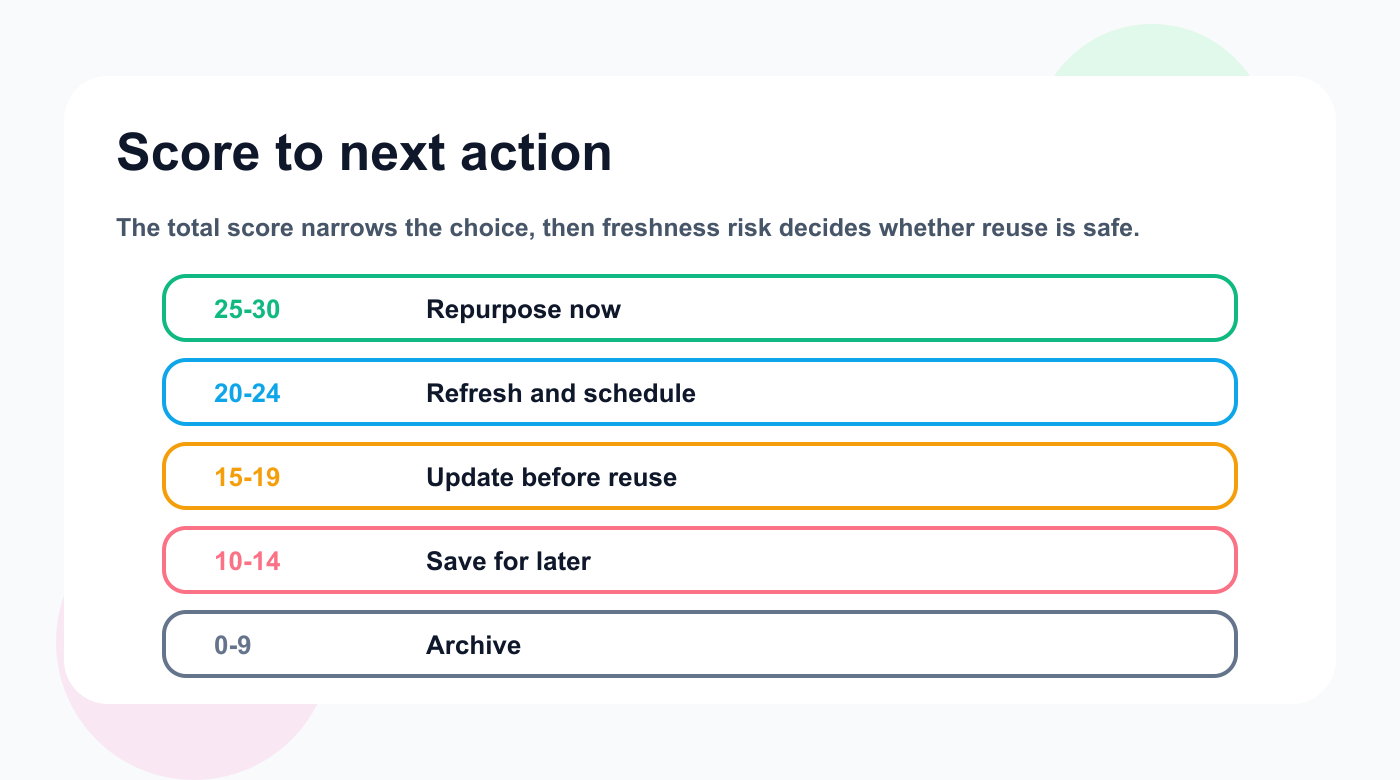
The total score narrows the action, then freshness risk decides whether reuse is safe.
Total scoreAction25–30Repurpose now20–24Refresh and schedule15–19Update before reuse10–14Save for later or test again0–9Archive
This is a guide, not a law.
A high-risk pricing post may need update even if it scores well elsewhere.
Repurposing action types
Repurpose now
Use when the post has strong performance, evergreen value, low risk, and multiple platform options.
Refresh and schedule
Use when the idea is strong but the hook, asset, CTA, or format could be better.
Update before reuse
Use when the idea is valuable but claims, screenshots, pricing, or context need review.
Save for later
Use when the topic may become useful in a future campaign.
Archive
Use when the post is outdated, weak, off-positioning, or not worth future effort.
Applying the scorecard
Example scorecard
PostPerformanceEvergreenAudienceBusinessPlatformFreshnessTotalActionApproval gate checklist55545529Repurpose nowOld pricing announcement42342116Update before reuseTrend meme51322417Save or archiveContent calendar tip45444526Repurpose now
This table can become a recurring monthly workflow.
How to move scores into a queue
Each high-scoring post should become a queue item.
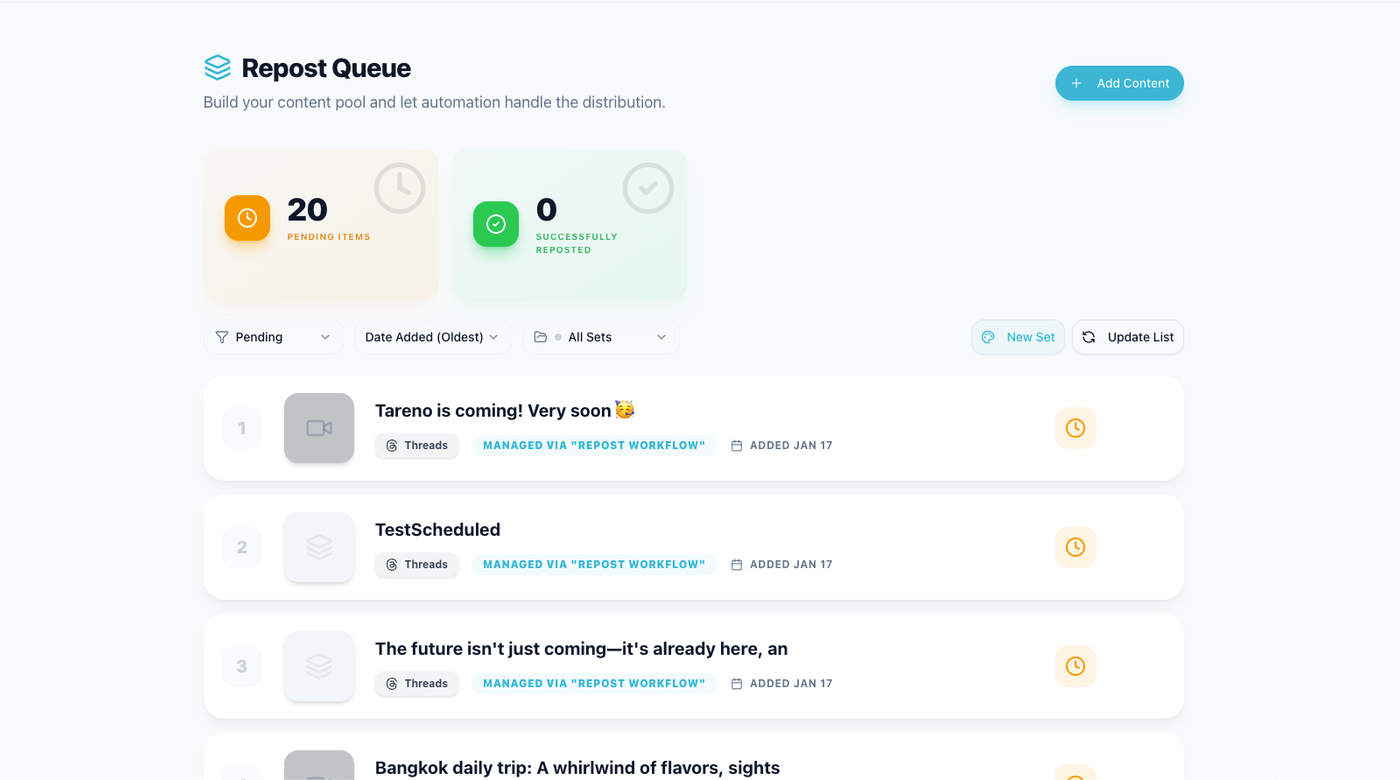
A queue turns a high score into an owner, format, schedule date, and second measurement cycle.
Queue fields:
source post
total score
strongest signal
target platform
new format
owner
freshness review needed
approval needed
scheduled date
second-wave measurement
Example:
Source post:
Approval gate checklist

Score:
29

Reason:
High saves and comments, evergreen, low risk.

Next version:
Instagram carousel and Pinterest pin.

Owner:
Content lead

Approval:
Marketing review

Measurement:
7-day saves and 30-day Pinterest clicks.
This turns scoring into production.
How Tareno fits the scorecard workflow
Tareno is useful when scoring needs to become action.
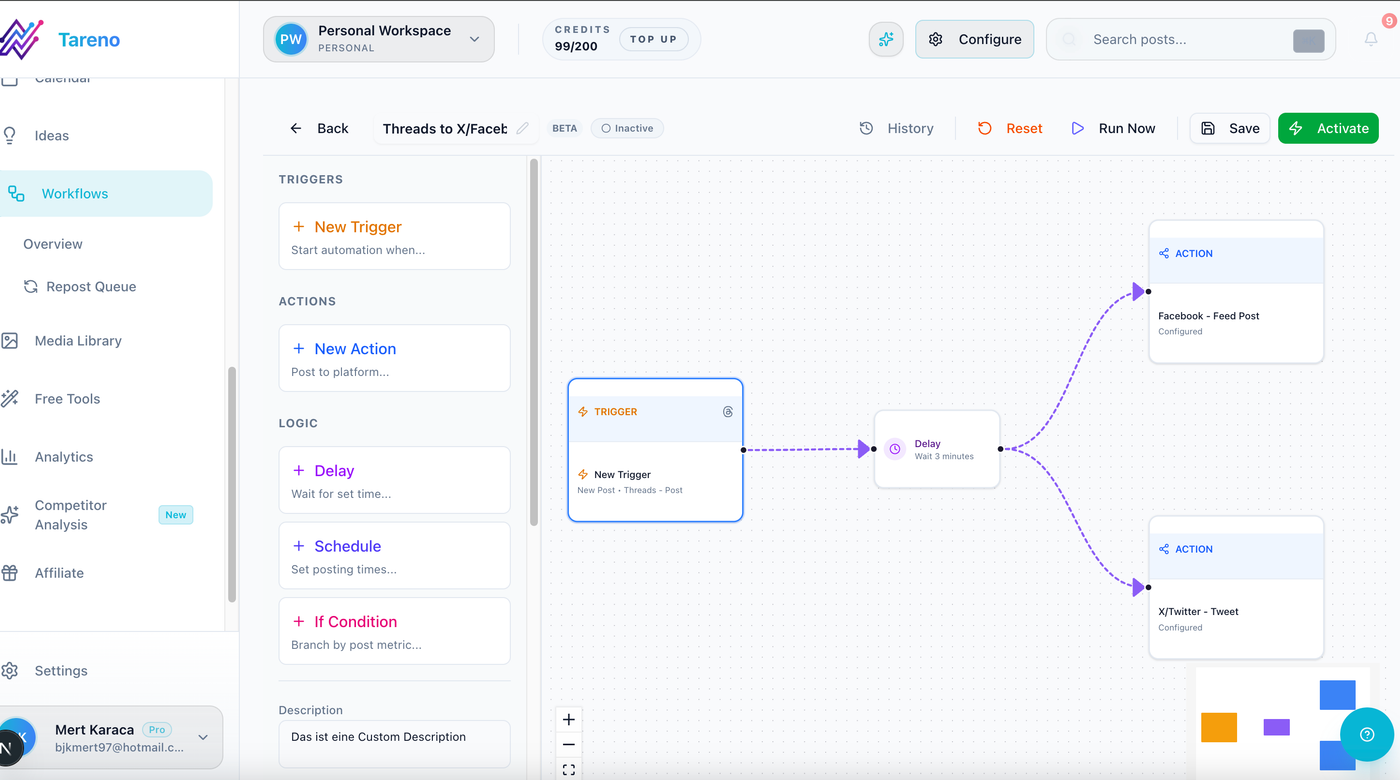
The scorecard becomes useful when the next action moves into a workflow.
Relevant Tareno components include:
analytics
content boards
repurposing queue
approval workflows
content calendar
workflow builder
team workspaces
roles and permissions
activity visibility
AI captions and hashtags
Make integration
n8n integration
API access
The workflow becomes:
analytics -> scorecard -> queue -> rewrite -> approval -> schedule -> measure again
This is the difference between storing old posts and building a repurposing system.
Copy/paste scorecard
## Repurposing Scorecard

Post:
Platform:
Original publish date:
Source URL:

Performance signal score:
Evergreen value score:
Audience relevance score:
Business relevance score:
Platform flexibility score:
Freshness risk score:

Total score:
Recommended action:
Target platform:
New format:
Owner:
Approval needed:
Measurement date:
Common mistakes
Mistake 1: Scoring by reach only
Reach is only one signal.
Mistake 2: Reusing outdated content
Freshness risk should always be checked.
Mistake 3: No owner
A high score means nothing without an owner.
Mistake 4: No platform adaptation
Repurposing should adapt the idea, not copy-paste it.
Mistake 5: No second measurement
Measure the reused content too.
Related Tareno resources
Turn scores into reuse
Feature Repurposing Queue Move high-scoring posts into a visible second-wave pipeline. See the queue -> Workflow Repurposing Workflow Map winning posts into platform-specific follow-up assets. Open workflow -> Feature Analytics Reports Use performance signals to decide what deserves another run. Review signals -> Alternative Buffer Alternative Look beyond simple queues when reuse needs approval and context. Compare tools ->
FAQ
What is a repurposing scorecard?
It is a scoring system that helps teams decide which old posts should be reused, refreshed, updated, saved, or archived.
What makes a post worth repurposing?
A post is worth repurposing when it has strong performance signal, evergreen value, audience relevance, business value, platform flexibility, and low freshness risk.
Should reach be the main repurposing metric?
No. Saves, shares, clicks, comments, watch time, and conversions can be more useful depending on the goal.
How often should teams score old posts?
Creators can score monthly. Agencies and teams can score during monthly or quarterly reporting.
Can AI help with repurposing?
Yes. AI can suggest new hooks, formats, platform versions, and captions. Human review should still check accuracy and brand voice.
How does a scorecard connect to an evergreen queue?
High-scoring posts should become queue items with owner, target platform, approval status, schedule date, and measurement plan.
Final thoughts
Repurposing should be selective.
The scorecard helps you choose what deserves a second life.
Look for performance signal.
Check evergreen value.
Confirm business relevance.
Review freshness risk.
Then turn winners into queue items.
That is how old content becomes future output.
Primary CTA: Explore Tareno features to see how analytics, repurposing queues, boards, approvals, workflow builder, Make, n8n, API, roles, and activity visibility support a better repurposing system.\n